Views: 0 Author: Site Editor Publish Time: 2026-02-17 Origin: Site
You can calculate production capacity for your small cup packaging operation by using straightforward formulas. First, assess how many hours your machines can operate and how many cups you can produce in that timeframe. To determine costs, sum up the price of materials, wages for workers, and any additional expenses. Following these simple steps will help you arrive at accurate results. SUNYI’s intelligent packaging solutions provide excellent examples for efficient operations.
Formula Type | Formula |
|---|---|
Machine Hour Capacity | number of usable machines × number of working hours |
Single Item Production Capacity | machine hour capacity ÷ time taken to produce an item |
Cost Type | Formula |
|---|---|
Total Manufacturing Cost | Direct Materials + Direct Labor + Manufacturing Overhead |
Cost of Goods Manufactured | Total Manufacturing Cost + Beginning Work in Progress - Ending Work in Progress |
Cost of Goods Sold | Beginning Inventory + Purchases - Ending Inventory |
Tip: Complete each step one at a time for optimal results.
Figure out how many cups you can make by checking machine hours and how fast cups are made. This helps you plan well and meet what customers want.
Use this formula: Production Capacity = (Number of Machines × Operating Hours × 60) ÷ Cycle Time. This shows how much you can make.
Know your costs by splitting them into materials, labor, and overhead. This helps you control spending and set good prices.
Use machines like SUNYI’s to do jobs automatically. This lowers labor costs and makes more cups. Automation can cut labor needs by up to 40%.
Keep machines in good shape to stop them from breaking. Check them often so production does not stop and repairs are not expensive.
Talk to suppliers to get discounts when buying lots of materials. This lowers the cost for each cup and helps you earn more money.
Use packaging that is good for the environment. This attracts customers who care about nature and makes your brand look better.
Look at how you make cups often to find problems. Fixing these early helps you work faster and waste less.
Knowing how to figure out production capacity is very important. It helps you run your cup packaging operation well. You need to find out how many cups your machines can make in a certain time. This lets you plan your work and fill customer orders. It also helps you stop mistakes that cost money. Here is how you can do it, step by step.
You can use a simple formula to start. First, check how many hours your machines work each day. Then, see how long it takes to make one cup. Divide the total machine hours by the time for one cup. This tells you how many cups you can make in one day.
For example, if your machine works for 8 hours (480 minutes) and needs 3 seconds to pack one cup, you can do this:
480 minutes × 60 seconds = 28,800 seconds
28,800 seconds ÷ 3 seconds per cup = 9,600 cups per day
There is another way called the takt time method. Takt time is the most time you can use to make one cup and still meet what customers want. To find it, divide the time you have by the number of cups you need. If you know your takt time, you can change your process to fit demand. This stops you from making too many or too few cups.
To get the right production capacity, you need some key facts. Here are the main things you should look at:
Drying time
Quantity splitting due to cutting patterns
Variability of machine capacity threshold
Number of orders
Order size
Order size variance
Order priority
Balance policy
Each thing on the list changes how your process works and what you get at the end. For example, if drying takes longer, you make cups slower. If you have lots of small orders, you might need to change your setup more. This can make you produce less.
After you have your facts, you can find out your capacity by doing these steps:
Write down how many machines you have.
Write how many hours each machine can work.
Check how long it takes to make one cup.
Use this formula:Production Capacity = (Number of Machines × Operating Hours × 60) ÷ Cycle Time (seconds per cup)
You can also use the takt time method to match what customers want. This helps you not make too many or too few cups.
Tip: Always look at your facts before you do the math. Small changes in your process can change your results a lot.
SUNYI’s cup packaging machines make it simple to find production capacity. Here are some real numbers:
Machine Type | Max Speed (Cups/Min) | Production Capacity (bph) |
|---|---|---|
Nespresso Coffee Capsule Filler and Sealer | 160 | 9600 |
Sunyi Skp-4 Four Lanes Nitrogen Flushing System | N/A | 9600 |
If you use the Nespresso Coffee Capsule Filler and Sealer, you can make up to 160 cups each minute. That means you can make 9,600 cups every hour. This high number helps you fill big orders fast and well.
You should also think about things that change how many cups you can make. Here is a table that shows what can change your results:
Factor | Impact on Production Capacity |
|---|---|
Regular Maintenance | Needed to keep machines fast; stops breakdowns and problems, so you lose less time. |
Facility Layout and Workflow | Good layout means less moving materials, so you save time and work faster. |
Volume of Orders and Demand | Big orders need faster work; you might need more machines or better ones. |
Sustainability Practices | Going green is important for the future, but it can slow down how fast you make cups. |
When you use SUNYI’s machines, you can figure out capacity easily. Their machines are made to work well and last a long time. You can change your process to reach your goals and help your customers.
By following these steps and using good machines, you can find out your production capacity for cup packaging. This helps you plan, use your resources well, and grow your business.
Knowing your costs helps you make good choices. You need to check material costs, labor costs, and overhead costs. Each part changes your total spending and how you run your business.
First, find out how much it costs to package each cup. Add the price of the cup, lid, and other packaging materials. Then, divide the total by the number of cups you make. For example, if you spend $500 on materials and pack 10,000 cups, each cup costs $0.05 for materials. This step helps you see your process and set your prices.
Buying a lot of materials at once can save money. Suppliers give discounts for big orders. If you buy 50,000 cups instead of 10,000, your cost per cup might drop from $0.05 to $0.03. This helps you manage production and earn more profit. You should watch these savings and change your buying plan to fit your needs.
Labor costs are the money you pay your workers. You need to know how many hours your team works and their pay per hour. For example, if three workers earn $15 an hour and work eight hours, you pay $360 each day. Labor costs can get high, especially for small batches. Yearly costs can be $500,000 to $800,000.
Automation changes how much you spend on labor. Machines like SUNYI’s cup packaging equipment mean you need fewer workers. Automation can cut workers by 30-40% and upstream labor by 50-75%. You can also make more cups, with 20-40% more output. Fewer injuries save you 50-70% on injury claims. Automation can pay for itself in 18-36 months. Here is a table that shows how automation changes labor costs:
Impact of Automation on Labor Costs | Reduction Percentage |
|---|---|
Reduction in headcount | 30-40% |
Reduction in upstream labor | 50-75% |
Increased throughput | 20-40% |
Reduction in injury claims | 50-70% |
Automation helps you run your business better and makes your process faster.
Overhead costs are things like rent and utilities. You pay $3,000 each month for your building. Utilities cost $1,200 each month plus a small part of your revenue. These costs stay about the same, so you must plan for them.
Office and Facility Rent: $3,000 per month
Production and Office Utilities: $1,200 fixed monthly plus 0.3% of revenue
Regular maintenance keeps machines working well. Inspections and routine jobs help you avoid sudden problems. Maintenance lowers repair bills and helps you work better. Service contracts from companies like SUNYI keep your machines in good shape. Good maintenance makes your equipment last longer and helps you control costs. It also protects your money and keeps your process smooth.
Maintenance controls spending.
Routine maintenance cuts downtime and saves money.
Service contracts keep equipment working well.
You need to track all these costs to run your business well. By watching material, labor, and overhead costs, you can manage your business better and make your process smoother.
You must know your total cost before setting prices or planning growth. The total cost formula adds up all the main costs in your cup packaging operation. These costs are direct materials, direct labor, and manufacturing overhead. When you add them together, you get your total manufacturing cost.
Here is a simple table that shows how this works:
Component | Amount |
|---|---|
Direct materials | $200,000 |
Direct labor | $150,000 |
Manufacturing overhead | $100,000 |
$450,000 |
You can use this formula to find your total manufacturing cost:
Total Manufacturing Cost = Direct Materials + Direct Labor + Manufacturing Overhead
Once you know your total manufacturing cost, you can find your cost per unit. Divide your total manufacturing cost by the number of cups you make. For example, if you make 100,000 cups, your cost per unit is $4.50.
Tip: Check your numbers every month. Small changes in material prices or labor hours can change your total cost.
SUNYI’s efficient machines help you lower your total cost in many ways. Their advanced quality control systems make sure you make high-quality cups. This means you have fewer defective products and your customers trust you more. Machines with low failure rates and short downtime keep your production steady. You do not lose time or money fixing broken machines. The modular design makes maintenance easy, so you spend less time and money on repairs. SUNYI’s material-saving roll film system cuts waste by 10-20%. You use less material, which lowers your production cost and helps the environment.
Here is a table that shows how SUNYI’s features help you save money:
Feature | Benefit |
|---|---|
Advanced quality control systems | Ensures high-quality products, reducing defective shipments and enhancing customer trust. |
Low failure rates & short downtime | Reduces equipment failure and downtime, ensuring stable production efficiency. |
Easy-to-operate modular design | Simplifies maintenance, reducing downtime and improving operational continuity. |
Efficient material-saving roll film system | Reduces waste by 10-20%, lowering production costs and enhancing material utilization. |
When you use the total cost formula and pick efficient machines, you can control your spending and make more profit. This helps your business grow and keeps your customers happy.
If you want to make your cup packaging faster, SUNYI has machines that help a lot. The SKP-1N and SC-6 models are both strong choices. The SKP-1N can make 50 coffee capsules every minute. This model is good if you only pack coffee capsules and want steady results. The SC-6 model has six lanes that work together. This means you can pack many kinds of products at the same time. You can use it for powders, liquids, or granules without slowing down.
Model | Production Output (pieces per minute) | Flexibility Description |
|---|---|---|
SKP-1N | 50 | Designed specifically for coffee capsules. |
SC-6 | N/A | Capable of handling a wider range of products with six lanes. |
The SKP-1N gives you a steady number of capsules. The SC-6 lets you switch between products easily. You can pick the machine that fits your business best.
SUNYI machines can pack many things. You can use them for coffee capsules, dairy cups, sauces, and more. You do not need a new machine for each product. This saves you money and space. It is also important to use different materials. About 45% of producers have problems when they change materials. SUNYI machines can use many types of resins and packaging materials. This helps your line keep running well.
Here is a table with features that change how much you can make:
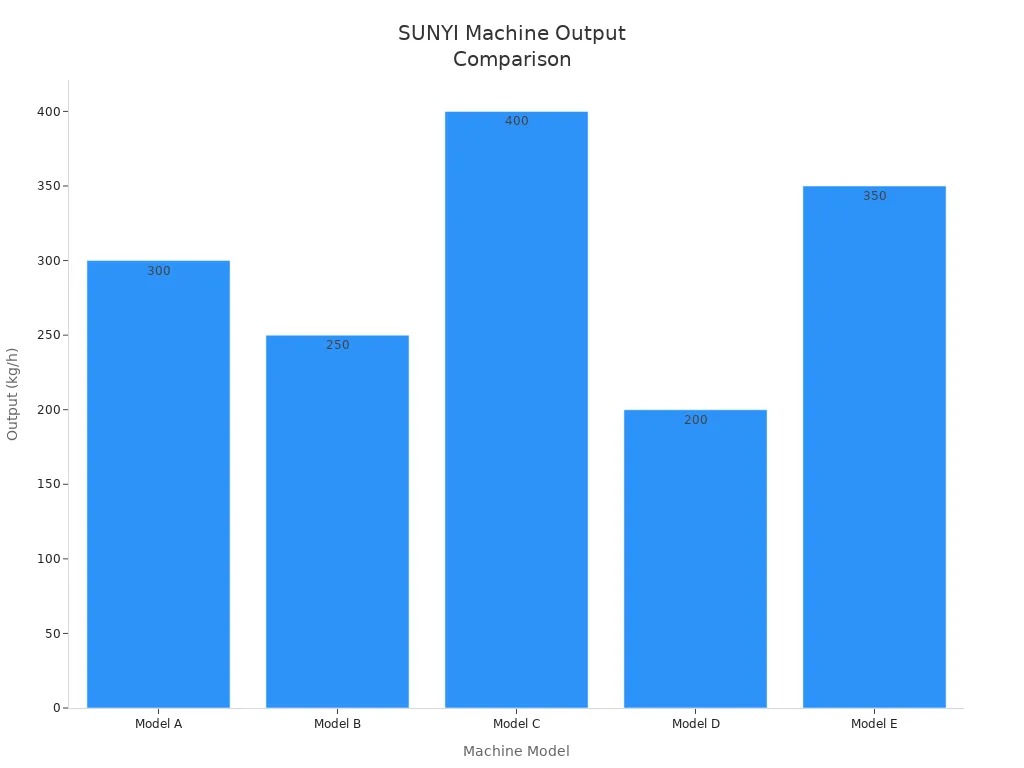
Machine Model | Output (kg/h) | Film Width (mm) | Layer Configuration | Features |
|---|---|---|---|---|
Model A | 300 | 1200 | 3 Layer | High Efficiency, Touch Screen Control |
Model B | 250 | 1500 | 5 Layer | Energy Saving, Compact Design |
Model C | 400 | 1000 | 3 Layer | Advanced Cooling System, High Precision |
Model D | 200 | 1800 | 7 Layer | User-Friendly Interface, High Output |
Model E | 350 | 1300 | 5 Layer | Compatible with Multiple Resins, Modular Design |
You can see how each model makes a different amount in the chart below:
New die technologies can help you make up to 30% more. Better control systems can help you use up to 25% less material. These features help you get more value from your machines.
You must follow strict rules to keep your products safe and high-quality. SUNYI machines help you meet these rules because they are clean and easy to wash. You can clean the machines fully, so your work stays safe and legal. The machines also work well with automated systems. This helps you keep your quality high all the time.
Compliance Area | Key Requirements |
|---|---|
Food Safety Modernization Act (FSMA) | Preventive controls, hazard analysis, supply chain management. |
Good Manufacturing Practices (GMP) | Facility design, personnel hygiene, documentation and recordkeeping. |
Packaging Materials Regulations | Safe food contact materials, migration limits, packaging material testing. |
International Standards | ISO 22000, NSF/ANSI 3-A 14159-1, European Machinery Directive. |
Electrical Safety Standards | Proper wiring and earthing, electrical component safety. |
SUNYI machines can fill many kinds of products. You can change them to fit different needs. This helps you follow many industry rules. You can trust your machines to work safely and smoothly, no matter what you are packing.
Bottlenecks can make your cup packaging line slow. These are spots where work gets stuck or moves too slowly. Bottlenecks can lower your output and make costs go up. You should find them early to keep things running well.
Some common bottlenecks in small cup packaging lines are:
Inefficiencies in Equipment: Machines might break down a lot or take too long to switch jobs. This makes your equipment less useful.
Product Loss and Waste: If filling is not right or packages break, you lose product and money.
Quality Control Deficiencies: Bad seals or wrong labels can cause recalls and make customers lose trust.
Regulatory and Compliance Pressures: You have to follow strict rules. This adds more steps and makes things harder.
Labor Dependency and Automation Gaps: If you use too much manual work, mistakes can happen and things go slower.
Flexibility and Customization Demands: Customers want different products and small batches. If your line cannot change fast, you lose time when switching.
Tip: Watch your line closely. Find the slowest part and fix it first.
Downtime is when machines stop working but should be running. This can happen for many reasons. Every minute your machines stop, you lose money and orders get late. You need to know why downtime happens so you can stop it.
Main reasons for downtime in cup packaging are:
Improper Sealing Issues: Wrong heat, low pressure, or bad alignment can stop your line. Check and fix machines often to prevent this.
Paper Jam Problems: Paper that is not lined up or trash can jam your machine. Clean machines and load paper right to stop jams.
Motor and Electrical Failures: Power surges or old parts can break machines. Check machines often and change bad parts fast.
Inconsistent Cup Quality: Changes in materials or settings can make cups worse. Keep checking quality to avoid this.
You can have less downtime if you do regular maintenance. Teach your team to spot problems early. Use machines with easy-to-change parts, like SUNYI’s, to start working again faster.
Having correct data is very important for your packaging operation. If your numbers are wrong, your plans will not work well. Good data helps you make smart choices about production and costs.
Here is why data accuracy is important:
Good data gives you true output numbers. This helps you plan how much you can make.
Correct numbers help you find bottlenecks. You can use your resources better.
Good data lets you make smart choices about growing and spending.
Data Accuracy Benefit | Impact on Operations |
|---|---|
Reliable output estimates | Better production planning |
Bottleneck identification | Improved resource allocation |
Informed decision-making | Smarter capacity and cost control |
Note: Check your data often. Use digital systems to make fewer mistakes and keep records up to date.
If you pay attention to these common challenges, your cup packaging operation can stay efficient and save money.
Scaling your cup packaging operation means getting ready to make more products as your business grows. You want to meet higher demand but not lose quality or spend too much. Many small businesses have trouble when they try to grow. You can beat these problems by planning ahead and making smart choices.
First, look at how things work now. Ask if your machines can do more work. If they cannot, you might need better machines. Modern packaging machines, like those from SUNYI, help you make more cups with less hand work. These machines are faster and more exact than old ones. You can make more cups and keep your quality high.
Here are some good ways to scale up your production:
Invest in Advanced Packaging Machinery
New machines can pack more cups each hour. They also make fewer mistakes and save money on workers. SUNYI’s smart machines have features like automatic filling and sealing. These help you handle bigger orders.
Maintain Control Over Production
Keep your process neat and organized. Make sure every step works well. Use checklists and schedules to watch your progress. If you find problems early, you can fix them before they slow you down.
Select Appropriate Packaging Materials
Pick materials that match your product and brand. Many customers care about the environment. About 43% of buyers want eco-friendly packaging. Using recycled or compostable materials can make your brand special. These choices also help you follow new rules about packaging waste.
Tip: Eco-friendly packaging helps the planet and brings in more customers who care about sustainability.
You should also watch your costs as you grow. Buying lots of materials at once can lower the price for each cup. Plan how many workers you need. Automation lets you do more with fewer people. This keeps your costs steady as you get bigger.
Here is a simple table to help you compare ways to scale:
Scaling Strategy | Benefit |
|---|---|
Advanced machinery | Higher output, less manual labor |
Process control | Fewer mistakes, smoother workflow |
Eco-friendly materials | Better brand image, meets regulations |
Scaling your production takes time and good planning. By picking the right machines, keeping your process in order, and choosing the best materials, you can grow your business with confidence. Stay flexible and always look for ways to get better. This will help you meet demand and keep your customers happy.
You can make your cup packaging work better by using some simple tips. First, look at how you do things now. Try to find ways to make each step faster and easier. Here are some things you can do: 1. Pick the right size materials for your cups. This saves money and makes less waste. 2. Use materials that are good for the environment. These help your business stand out. 3. Add smart technology to your packaging. This helps you keep track of supplies. 4. Use machines to pack cups. Machines like SUNYI’s can help you work faster and pay less for workers. 5. Plan how you move and store your products. Good planning saves space and cuts shipping costs. 6. Make returns easy to handle. A good system for returns saves time and money. 7. Try to reuse and recycle as much as you can. This helps the planet and your business. 8. Work with partners who bring new ideas. New ideas can help you make better packaging.
When you make your process better, you can make more cups in less time. You also keep your costs lower.
Cutting down on waste is good for your money and the earth. You can do a few things to make less waste in your packaging: - Get your materials from suppliers who care about the environment. - Design your packaging to use less material. - Teach your team how to handle and throw away waste the right way. - Use packaging that can be recycled when possible. - Choose packaging sizes that fit your products well.
These actions help you spend less and make your business greener. SUNYI’s machines also help you waste less by saving materials.
Getting lower prices from suppliers helps you spend less. You can try a few ways to get better deals: - Ask for discounts when you buy a lot at once. - Try using different materials that might cost less. - Build strong relationships with your suppliers for better deals.
For example, someone in charge of buying at a big food company saved 10% on packaging by picking a greener material and making a long contract with a trusted supplier.
You should also check your contracts, look at market prices, and set clear goals before you talk to suppliers. These steps help you get the best deals and make your business run better.
You can get more done in your cup packaging operation by making labor easier. When you organize your team and use the right tools, you stop problems and machine stops. This means your workers and machines stay busy all day.
First, look at how your team works now. Ask if people spend too much time on jobs that machines could do. Automation helps you do less work by hand. SUNYI’s smart packaging machines can fill, seal, and check quality. With automation, workers can focus on checking quality and fixing problems instead of doing the same thing over and over.
Here are some ways to make labor easier in your cup packaging operation:
Buy machines to do jobs by hand and work faster.
Teach your team often so they know how to use new machines and make fewer mistakes.
Use lean packaging ideas to remove steps that do not help.
Add smart technology to see data right away and track better.
Make inventory better so you always have materials when you need them.
Training your team all the time is important. When workers learn new ways to package, they work faster and make fewer mistakes. This saves time and materials. It also helps workers feel sure of themselves and ready for new problems.
Lean packaging means you only use what you need. You skip extra steps and materials. This keeps your work simple and quick. For example, put everything close together in your workspace. Workers do not waste time walking far.
Smart packaging technology gives you data right away. You can see how many cups you pack each hour. If something slows down, you find it fast and fix it. SUNYI’s machines have digital controls and systems to watch your line. These tools help you keep things running well.
Here is a table that shows how making labor easier helps you:
Action | Benefit |
|---|---|
Automation | Fewer manual tasks, higher productivity |
Staff training | Fewer errors, better use of equipment |
Lean packaging principles | Less waste, faster workflow |
Smart technology integration | Real-time tracking, quick problem-solving |
Inventory management | No delays from missing materials |
Tip: Check your workflow every month. Small changes can help you make more and spend less.
When you make labor easier, you use your resources better. You get more done, spend less money, and help your team focus on making good products for your customers.
You can use these main formulas to figure out your cup packaging operation’s capacity and costs. Keep this table close when you plan or check your production.
Formula | Description |
|---|---|
(Actual output ÷ Potential output) × 100. This shows how much of your total possible output you are using. | |
Production Capacity | Machine-hour capacity ÷ Cycle time for each unit. This tells you how many cups you can make in a certain time. |
Machine-hour Capacity | Number of usable machines × Number of working hours. This helps you see how much work your machines can do. |
Tip: Use these formulas every time you check your production numbers. This helps you find problems early and keep your operation running well.
A good checklist helps you stay organized and keeps your cup packaging line working well. Use this template to track important jobs and details for ongoing production capacity and cost control.
Capacity Planning: Check your machine hours and plan how to use them.
Change Log: Write down any changes you make to your production plan.
Cost Tracking: Record all costs, like labor, materials, and overhead.
Demand Forecasting: Enter your sales guesses to help plan production.
Dependencies and Constraints: Note any jobs or resources that could slow you down.
Inventory Levels: Track how much raw material, work-in-progress, and finished goods you have.
Material Requirements: List what materials you need and how much of each.
Notes and Comments: Add any extra information or instructions for your team.
Performance Metrics: Watch key numbers like efficiency, throughput, and on-time delivery.
Product Information: Include product names, descriptions, and SKUs.
Production Quantities: Write how many units you plan to make for each product.
Production Sequence: List the order of jobs or batches.
Resource Allocation: Assign machines, equipment, and workers to each job.
Quality Control Checkpoints: Plan checks to make sure products meet your standards.
Status Updates: Mark if jobs are planned, in progress, or done.
Supplier Information: Keep supplier names, lead times, and order amounts handy.
Time Frames: Note start and end dates for each job or batch.
Use this checklist before every production run. It helps you catch mistakes, save money, and keep your packaging operation on track.
You can figure out your cup packaging capacity and costs by following easy steps and using simple formulas. SUNYI’s machines help you finish work faster and spend less money. Check your process often to see what you can make better. Use the checklist to keep everything in order. The table below shows smart ways to keep doing well:
Strategy | Benefit |
|---|---|
Real-time monitoring | Spots slow spots before they become a problem |
Automated data collection | Gives you correct numbers and helps stop mistakes |
Predictive analytics | Lets you fix machines before they break during busy times |
Integrated systems | Links your packaging to your whole production plan |
Find more ideas at SUNYI’s website.
Capacity planning means figuring out how many cups you can pack in a certain time. You need to look at your machines, workers, and materials. This helps you fill orders on time and not fall behind.
Small businesses need capacity planning so they do not make too many or too few cups. It helps you use your machines and workers the best way. You can save money and keep your customers happy if you plan well.
You should check your capacity planning every month. Orders, machine speed, or worker shifts can change. Checking often helps you find problems early and fix your plan.
Yes, capacity planning shows where you waste time or materials. You can fix these problems and spend less money. Good planning also helps you buy just what you need.
You can use spreadsheets, special computer programs, or simple charts for capacity planning. Many people start with a checklist. Machines like SUNYI’s have digital tools that help you plan.
Capacity planning helps you know how long orders will take. You can give delivery dates you can really meet. This makes your customers happy and helps them trust you.
If you do not plan, you might run out of products or miss deadlines. You could also waste money on extra materials. Your business might lose customers if you do not plan well.
You can make capacity planning better by watching your numbers, teaching your team, and using better machines. Check your plan often. Ask your team for ways to make planning work better.