Views: 0 Author: Site Editor Publish Time: 2026-10-13 Origin: Site
Manual carton packing often works well when a prepacked snack product is new, order quantities are small, or the carton format changes frequently. As repeat orders grow, however, forming boxes, counting individual packs, arranging them correctly, and closing every carton by hand can become the slowest part of the production line.
An automatic cartoning machine for prepacked snacks is designed to control these repetitive secondary-packaging steps. It receives products that have already been sealed in sachets, stick bags, stand-up pouches, or another compatible format and loads them into paperboard cartons. For stable products and longer production runs, automation normally provides more consistent output, product counts, carton formation, and sealing than manual packing.
Comparison Area | Manual Carton Packing | Automatic Cartoning |
|---|---|---|
Production output | Changes with staffing, experience, fatigue, and shift conditions | Follows a controlled cycle when product supply is stable |
Product counting | Relies on operators and manual checks | Products can be counted and grouped according to the carton recipe |
Loading arrangement | May vary between operators | Repeats the configured orientation and loading pattern |
Carton consistency | Folding and closing quality may vary | Repeats the same forming and sealing sequence |
Labor use | Requires people for several repetitive packing steps | Reduces routine manual forming, loading, and closing work |
Changeovers | Flexible for small and frequently changing orders | Requires format adjustment, tooling, or recipe changes |
Initial investment | Relatively low | Includes equipment, tooling, integration, and training |
Best application | Trials, low volumes, and highly variable products | Repeat orders, batch production, and stable packaging formats |
The strongest reason to automate is not simply maximum speed. It is the ability to maintain a predictable packing process throughout a production run. This makes output planning easier and reduces the variation that can occur when product counting, box forming, loading, and closing depend entirely on manual work.
A cartoning machine is a secondary packaging machine. It does not normally weigh loose nuts, fill chips into bags, dose powders, or seal the primary package. Those operations take place before cartoning.
In this comparison, a prepacked snack is a product that has already been filled and sealed in a compatible primary pack. The cartoner then counts or groups the finished packs, forms the paperboard carton, loads the required quantity, and closes the carton.
SUNYI’s automatic cartoning machine range includes equipment for different product shapes and carton structures. Relevant formats can include:
Prepacked sachets
Sealed stick bags
Stand-up pouches
Coffee capsules
Other compatible single-serve packs confirmed through sample testing
For snack applications, the most relevant formats are usually sachets, stick bags, and stand-up pouches. The contents may vary, but the cartoner handles the external pack rather than the food inside it. Product dimensions, weight, rigidity, trapped air, seal position, surface friction, and required count per carton all influence the correct infeed and loading method.
This distinction prevents a common specification mistake. A machine that can load a sealed pouch into a carton should not automatically be described as a machine that fills or seals that pouch. Primary packaging and cartoning can be connected as one production line, but they remain separate processes.
Manual packing speed depends on how quickly operators can form cartons, count products, load them, and close the flaps. Output can change during breaks, shift changes, staff shortages, and long working periods. Adding more people may increase capacity, but it also requires additional workstations, supervision, and material movement.
Automatic cartoning uses a coordinated mechanical and control sequence. Carton blanks are supplied from a magazine, prepacked products arrive through the infeed, and the machine completes the configured forming, loading, and sealing cycle. When upstream product supply is stable, this controlled sequence helps the cartoning stage keep pace with repeat orders and scheduled batch production.
Output should always be compared in finished cartons rather than only individual packs. Loading one pouch per carton is different from counting and arranging ten sachets in each box. Carton size, product count, loading pattern, inspection functions, and changeover frequency all affect usable production capacity.
Manual multipack assembly creates a greater opportunity for missing or incorrectly arranged products, particularly when small sachets or stick bags look similar. These mistakes can lead to rework, stock discrepancies, distributor complaints, or rejected retail cartons.
An automated infeed can count and group products according to the selected carton recipe. This makes a sachet cartoning system useful when every box must contain the same quantity and arrangement of small flexible packs.
The level of inspection should be selected for the actual project. Sensors, checkweighing, vision inspection, and rejection functions may be considered when missing, damaged, or incorrectly oriented packs create a significant quality risk. These functions should be confirmed as part of the proposed configuration rather than assumed to be standard on every machine.
Retail cartons need more than the correct product count. They also need consistent dimensions, square corners, properly positioned flaps, and reliable closure. Manual folding and gluing can produce visible differences between operators or shifts, especially during large orders.
An automatic cartoner repeats the same forming and sealing movement. Consistent carton geometry also supports downstream conveying, coding, inspection, and case packing. The result still depends on the quality of the paperboard blank, cutting and creasing accuracy, adhesive selection, and carton design. Automation cannot compensate for unsuitable carton materials, but it can apply a stable process to cartons that meet the agreed specification.
Automatic cartoning can reduce the number of repetitive steps performed by hand. Staff can instead focus on supplying carton blanks, monitoring the line, checking finished packs, completing changeovers, and responding to faults.
The amount of labor saved varies by factory. It depends on the current packing method, number of shifts, carton complexity, product count, inspection requirements, and upstream integration. It is better to conduct a time study on the existing manual line than to rely on a general claim about how many operators one machine will replace.
Small flexible packs often require counting, stacking, and orientation before loading. Their lightweight structure can make them difficult to control if they overlap, curl, or arrive irregularly. A snack sachet cartoning machine therefore needs an infeed designed around the pack dimensions, seal shape, surface, and required quantity.
If several flavors are packed into one assortment carton, the system must also control the sequence. A simple single-SKU multipack is normally easier to automate than a frequently changing mixed assortment.
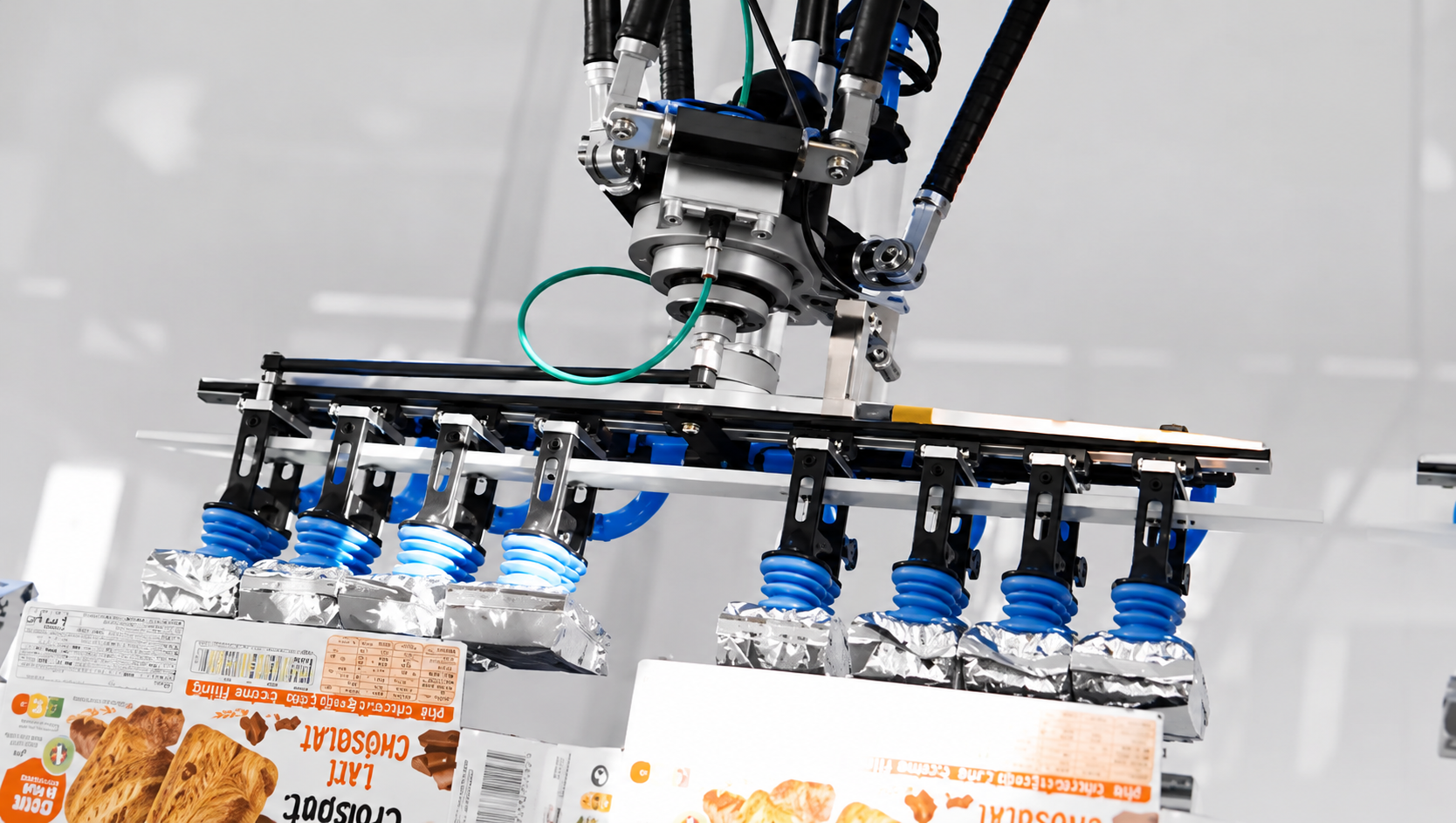
Stand-up pouches are larger and may contain air or movable product. A top-loading cartoner for pouches must pick, support, and place each pack without damaging the seals or distorting the carton. The loading pattern should be tested with filled production samples because an empty pouch does not behave like a finished product.
SUNYI’s SA-50 top-loading cartoner is designed for coffee capsules, sachets, stick bags, and stand-up pouches. It uses flat paperboard blanks, automatic product loading, and hot-melt glue sealing. Its operating capacity is approximately 20–30 boxes per minute, depending on the product, carton, quantity per box, and final configuration.
One automatic cartoning machine may support several products when their dimensions and handling requirements fall within its designed range. However, multi-format capability does not mean that every pack can run with no mechanical adjustment.
Different SKUs may require new guides, molds, picking tools, carton magazine settings, robot programs, or HMI recipes. If production involves many short batches, changeover time can be more important than maximum machine speed. The supplier should identify which changes are automatic, which are tool-free, and which require replacement format parts.
Manual packing remains practical when flexibility is more valuable than sustained output. It may be the better choice when:
A product is still being tested and order volume is uncertain.
Carton structures or product combinations change frequently.
Production runs are too short to recover the time required for machine setup.
The primary packs are irregular or difficult to orient automatically.
Assortment cartons use constantly changing flavor combinations.
The upstream line cannot supply products at a stable rate.
The factory does not yet have the space, utilities, or technical support required for automation.
Some producers begin with manual loading and automate carton forming or sealing first. This semi-automatic approach can reduce repetitive folding and gluing while retaining flexibility for short runs. As volumes become more predictable, automatic counting, grouping, and loading can be considered.
The decision should therefore be based on the production profile rather than the assumption that the highest automation level is always necessary.
The cost of manual carton packing is spread across wages, training, supervision, overtime, floor space, inspection, rework, and inconsistent output. The cost of automation is more visible because it includes the machine, tooling, integration, utilities, maintenance, and operator training.
For a realistic comparison, review:
Current saleable cartons produced per shift
Operators assigned to forming, counting, loading, and sealing
Fully loaded labor cost across all shifts
Rework caused by incorrect counts or poorly closed cartons
Overtime and temporary labor during peak orders
Floor space occupied by the manual packing area
Expected machine output using the actual product count and carton format
Changeover, cleaning, and planned maintenance time
Electricity, compressed air, adhesive, and spare-parts requirements
Additional capacity that can genuinely be used by the business
Do not calculate return on investment from the machine’s maximum speed alone. The useful figure is the number of acceptable cartons produced during normal scheduled operation. If the upstream packaging machine stops frequently or format changes consume a large part of each shift, theoretical speed will not represent real production.
An accurate quotation requires more than a general product name. You should provide filled primary packs and production-grade carton blanks, not empty bags or approximate drawings.
Confirm the following before ordering:
Product dimensions, weight, rigidity, and incoming orientation
Required number of packs in each carton
Loading arrangement and assortment rules
Carton drawing, paperboard material, and closure method
Required output in finished boxes per minute
Current and future SKU range
Upstream machine speed and discharge arrangement
Buffering and control communication between machines
Downstream coding, inspection, case packing, or palletizing needs
Changeover procedure and required format parts
Cleaning access and routine maintenance requirements
Factory acceptance test conditions
Installation, training, warranty, and spare-parts arrangements
SUNYI is an automatic cartoning machine manufacturer producing filling, sealing, cartoning, and case-packing equipment. Its custom packaging solutions can be evaluated around the primary pack, carton structure, loading pattern, and line-integration requirements.
Before shipment, the agreed configuration should be tested with representative products and cartons. The test plan should define the operating period, target output, acceptable rejects, product count, carton quality, changeover procedure, and inspection functions. You should also confirm available packaging machine after-sales service, remote support, training, and spare-parts arrangements for the installation market.
Automatic cartoning is generally more suitable than manual packing when prepacked snacks are produced in repeat orders and stable batches. It provides a controlled method for counting, grouping, loading, forming, and sealing cartons while reducing dependence on repetitive manual work.
Manual packing remains useful for product trials, short runs, irregular packs, and frequently changing assortments. Before automating, define the primary pack, carton structure, quantity per box, realistic output, changeover frequency, and line interfaces. You can then discuss the cartoning application using actual product and carton samples.
Normally, no. Loose products must first be filled and sealed in a suitable primary package. The cartoning machine then places the finished sachets, stick bags, pouches, or other compatible packs into paperboard cartons.
It can provide more consistent product counting, grouping, orientation, carton forming, and sealing when the equipment is correctly configured. Inspection functions should still be selected according to the risks of the application.
Common formats include sachets, stick bags, and stand-up pouches. Compatibility depends on the pack dimensions, weight, rigidity, trapped air, surface properties, seal position, and required loading arrangement.
Automation is worth evaluating when repeat orders create stable carton volume, manual packing limits upstream production, product counts must remain consistent, or labor and rework costs continue to increase. There is no universal carton-volume threshold for every factory.
Yes, when the products and cartons fall within the machine’s designed range and the required format parts and recipes are available. The differences between SKUs and the frequency of changeovers should be reviewed before the configuration is approved.
Provide filled and sealed product samples, production-grade carton blanks, carton drawings, the required quantity per box, loading pattern, target output, and details of upstream and downstream equipment.