Views: 0 Author: Site Editor Publish Time: 2026-09-02 Origin: Site
The rapid growth of the single-serve premium tea market creates a production bottleneck for co-packers and brands moving from manual processes to automated lines. Matcha is a high-value, highly hygroscopic, fine-particulate powder. Balancing throughput with strict dosing precision, dust control, and capital efficiency requires a calculated equipment choice. While flexible packaging utilizes Vertical Form Fill Seal (VFFS) technology for sachets, rigid single-serve formats demand specialized rotary or linear indexing systems. The decision between a single-lane and a dual-lane system dictates production capacity, facility footprint, maintenance complexity, and long-term unit costs. You need machinery that handles airborne particulates without compromising seal integrity. We will break down the mechanical realities of scaling from single to dual-lane configurations, helping you match equipment capabilities directly to your production volume and facility constraints.
Throughput Thresholds: Single-lane systems typically max out at lower capacities, making them ideal for pilot runs or regional distribution, while dual-lane systems effectively double output (often 30–80+ units/min) without doubling the footprint.
Precision Mechanics: High-speed dual-lane systems often necessitate advanced servo-driven augers for dosing, whereas entry-level single-lane machines may rely on stepper motors, impacting long-term accuracy.
The Scaling Sweet Spot: Dual-lane systems offer a highly efficient middle ground, providing significant automation gains without the extreme capital and operational complexities of massive 4-to-12 multi-lane configurations.
Cost vs. Yield: The lower initial investment of a single-lane machine is attractive, but the higher CapEx of a dual-lane system is often offset by reduced labor costs and minimized product giveaway—a critical factor when handling premium organic matcha.
Implementation Reality: Upgrading to dual-lane requires stricter environmental controls (humidity/dust extraction) due to the increased volume of powder being displaced simultaneously.
Matcha powder behaves like toner dust on the production floor. It is incredibly fine, typically around 10 microns, and highly susceptible to static electricity. This makes matcha powder capsule filling a complex engineering task. Standard auger fillers fail because the powder bridges in the hopper or free-flows uncontrollably past the tooling. You need custom-machined flights and dedicated agitation mechanisms to maintain a consistent bulk density within the hopper. Static elimination is another strict requirement. As powder moves through the stainless steel dosing funnel, it generates a static charge. This charge causes fine particles to repel each other and cling to machinery surfaces. Integrating static elimination bars neutralizes this charge immediately. Active dust extraction systems must sit directly at the filling station. These vacuums pull airborne particles away from the sealing zone before they settle. If you ignore dust control, you will fight constant seal failures.
Dosing variance directly impacts profit margins. Premium matcha is an expensive raw material. If your machine overfills each capsule by just 0.2 grams, the cumulative financial loss over a production year destroys profitability. Underfilling leads to consumer complaints and regulatory compliance issues. Strict weight control is a mandatory requirement for profitable organic matcha capsule filling. Achieving this precision requires tight integration between the dosing servo and the check-weighing feedback loop. The machine must constantly monitor the weight of filled capsules and automatically adjust auger rotation to compensate for slight variations in powder density. This closed-loop communication prevents product giveaway. It ensures every single cup meets the declared label weight. We regularly see facilities lose thousands of dollars monthly simply because their auger tooling lacks the necessary feedback loop to correct minor density shifts on the fly.
Matcha oxidizes rapidly when exposed to oxygen and light. Oxidation degrades the vibrant green color, flattens the flavor profile, and destroys antioxidant properties. To preserve the product, you must displace ambient oxygen inside the capsule before sealing. Nitrogen flushing capabilities are non-negotiable. The filling machine must feature an enclosed nitrogen tunnel covering the capsules from the filling station through to the sealing station. High-quality systems monitor residual oxygen levels in real-time. The target is a residual oxygen level below 1%. This strict atmospheric control extends shelf life and guarantees a premium experience for the consumer. You must verify that the nitrogen flow rate matches the machine speed. If the machine runs too fast, the nitrogen won't have enough time to displace the heavier oxygen molecules, leaving your product vulnerable to rapid degradation on the retail shelf.
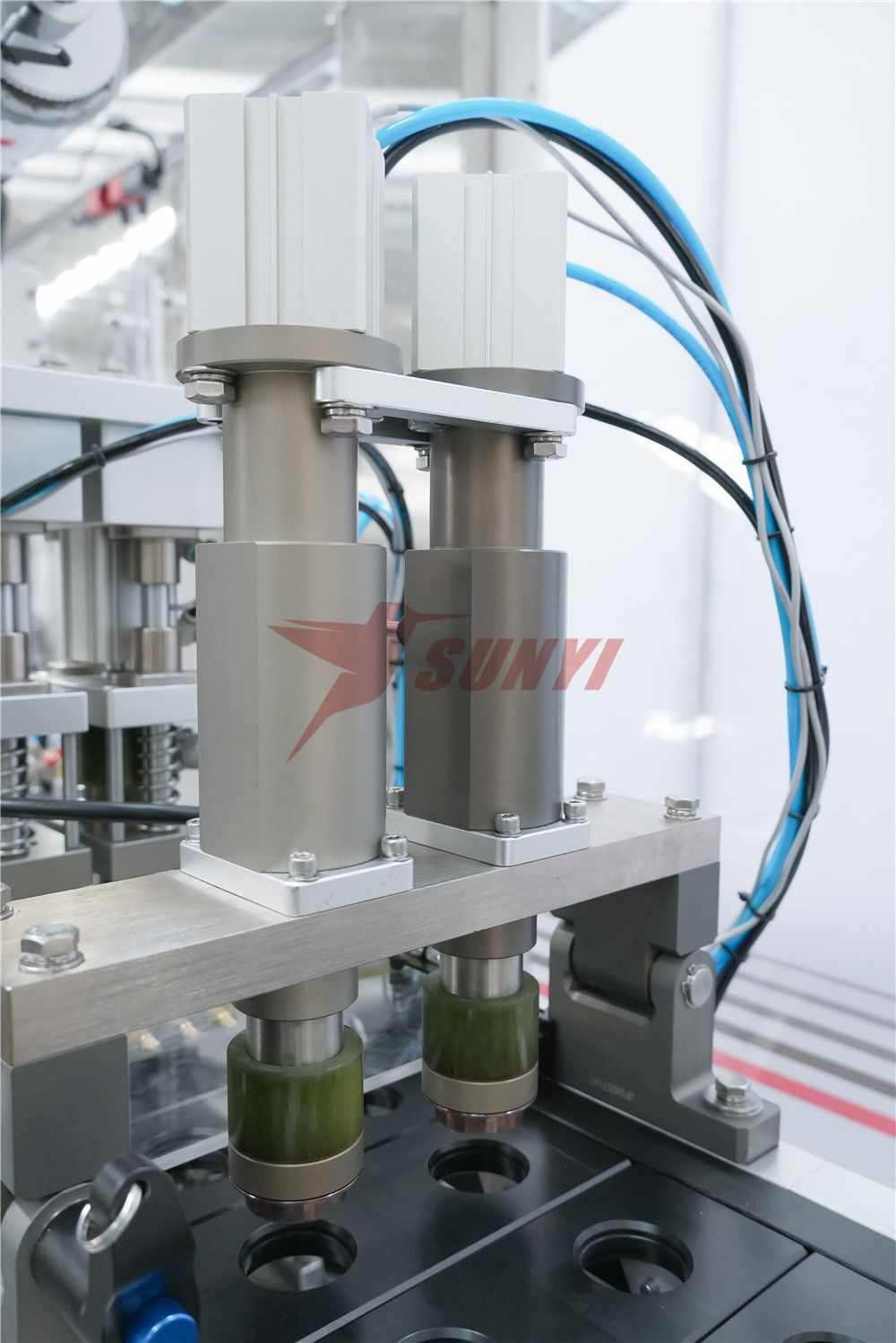
The final step is applying the lid. Whether you use pre-die-cut aluminum lids or roll-stock film, the cutting and sealing process must be flawless. Accurate film cutting ensures the lid aligns perfectly with the rim of the rigid cup. Misaligned lids result in weak seals and aesthetic defects. Heat sealing requires precise temperature and pressure control. The sealing head must apply uniform pressure across the entire rim. If dust extraction fails and powder contaminates the seal zone, the heat sealer burns the matcha into the plastic. This creates microscopic channels where oxygen enters and nitrogen escapes. A hermetic seal is only possible when the rim is completely free of particulate matter. Operators must routinely check the sealing heads for carbon buildup, as even a millimeter of residue will compromise the pressure distribution and cause micro-leaks.
A single-lane machine operates on a straightforward mechanical principle. It utilizes a single linear or rotary track to move rigid cups through the packaging sequence. The standard operational sequence includes feeding the empty cup, dosing the powder, tamping the product, applying the lid, heat sealing, and ejecting the finished capsule. Every action happens sequentially along one path. Because all actions are localized to a single lane, mechanical complexity remains low. The auger filler dispenses one dose at a time. The sealing head stamps one lid at a time. This simplicity makes the machine easier to operate and maintain. However, this sequential, one-by-one processing inherently limits the maximum speed of the equipment. You are bound by the cycle time of the slowest station, which is typically the auger dosing phase when handling fine powders.
This equipment configuration fits startups and emerging brands perfectly. If you are launching a new product line, a single-lane machine minimizes initial capital risk. It provides necessary automation to move away from manual filling without requiring a massive financial commitment. It is highly suitable for specialized small-batch runs or seasonal flavor variations. Facilities with strict space constraints often favor single-lane systems. The compact footprint allows the machine to fit into smaller production rooms. You can integrate it alongside existing equipment without requiring major facility modifications. For regional distribution models where demand is steady but not overwhelming, a single-lane setup delivers reliable, consistent output. Maintenance teams also appreciate the accessibility of single-lane chassis, as troubleshooting pneumatic faults or replacing a worn heating element takes minutes rather than hours.
The primary limitation of a single-lane system is the hard ceiling on units-per-minute. Eventually, sales volume outpaces the machine's maximum capacity. Pushing a single-lane machine beyond its rated speed leads to increased wear and tear, compromised dosing accuracy, and higher defect rates. You cannot force the machine to run faster than its mechanical limits allow. Scaling production with single-lane machines eventually requires purchasing multiple identical units. This strategy quickly becomes inefficient. Running three single-lane machines means you need three operators. You must maintain three separate sets of tooling. You also consume three times the floor space. This multiplication of labor, maintenance, and footprint requirements ultimately drives up operational costs and creates unnecessary logistical hurdles on the production floor.
A dual-lane system fundamentally changes the production dynamic by processing two containers simultaneously. This 2-up integrated design synchronizes every step of the packaging process. The machine feeds two empty cups, dispenses two doses of powder, applies two lids, and seals two capsules at the exact same time. All synchronized actions occur within a single, unified chassis. This synchronization requires advanced engineering. The machine utilizes dual augers driven by independent servo motors. The indexing system must move two cups perfectly in tandem. The nitrogen flushing tunnel must be wide enough to cover both lanes without losing gas pressure. Despite the increased mechanical density, a well-engineered matcha cup filling machine maintains tight control over both lanes simultaneously. The PLC logic must account for micro-adjustments on lane A without disrupting the cycle on lane B.
Throughput advantages of a dual-lane system are substantial. By processing two cups per cycle, you effectively double output without doubling the machine's physical size. A robust dual lane matcha filling machine easily achieves speeds of 30 to 80+ cups per minute, depending on specific fill volume and powder characteristics. This architecture maximizes output per square foot of manufacturing space. Instead of sprawling your production line across a massive warehouse, you consolidate high-volume output into a highly efficient footprint. This spatial efficiency is crucial for growing facilities that want to increase capacity without relocating to a larger building. The automation gains directly translate to a lower manufacturing cost per unit, allowing brands to compete more aggressively on retail shelves.
Upgrading to a dual-lane system requires careful facility planning. Infrastructure demands are significantly higher than those of a single-lane unit. You will need heavier power drops to support additional servo motors and heating elements. The machine requires an upgraded compressed air supply to drive pneumatic actuators across both lanes simultaneously. Keeping the machine supplied with raw material becomes a logistical challenge. You cannot manually dump bags of matcha into the hopper fast enough to keep up with dual augers. You must install robust bulk-powder feeding systems, such as vacuum conveyors or screw elevators. These automated feeding systems ensure a continuous supply of powder, preventing machine starvation and downtime. You also need to verify that your HVAC system can handle the increased heat load generated by the dual sealing stations operating at high speeds.
The drive mechanism behind the auger filler dictates long-term dosing accuracy. Entry-level single-lane machines often utilize stepper motors. Stepper motors move in discrete steps and operate on an open-loop system. They are cost-effective and provide adequate precision for low-speed applications. However, at higher speeds, stepper motors lose steps, resulting in inconsistent fill weights. Dual-lane systems absolutely necessitate servo motors. Servo motors operate on a closed-loop system, constantly communicating their exact rotational position back to the machine's PLC. This allows for rapid acceleration, precise deceleration, and absolute repeatability. When running two lanes at high speeds, servo control is the only way to guarantee that both augers dispense the exact same amount of powder every single cycle. We never recommend stepper motors for matcha due to the high cost of product giveaway.
Floor space is a premium asset in any manufacturing facility. When comparing the space-to-output ratio, the dual-lane architecture is vastly superior. A dual-lane machine is wider than a single-lane unit, but it is significantly more compact than placing two single-lane machines side-by-side. By consolidating production into one chassis, you eliminate the need for duplicate control panels, duplicate outfeed conveyors, and duplicate operator walkways. This efficient utilization of floor space allows you to install secondary packaging equipment, such as cartoners or case packers, in the space you saved. Maximizing layout efficiency improves overall workflow and material handling. Forklift traffic and pallet staging become much easier to manage when your primary filling equipment occupies a smaller, centralized footprint.
Format flexibility is important if you plan to run multiple cup sizes. Switching capsule formats requires mechanical changeovers. On a single-lane machine, this process is relatively fast. You swap out one set of cup holders, one dosing funnel, and one sealing head. Downtime is minimal, making it ideal for facilities that run frequent, small batches. Dual-lane systems inherently increase changeover duration. You must calibrate two sets of tooling. Aligning dual sealing heads and synchronizing dual augers takes more time and requires a higher level of technical skill from your maintenance team. If your production schedule requires changing formats multiple times a day, the increased downtime on a dual-lane system can erode overall equipment effectiveness. You must weigh the high-speed benefits against the reality of longer mechanical changeovers.
Both systems must eventually feed into secondary packaging. The way they integrate differs significantly. A single-lane machine discharges cups in a steady, single-file line. This makes it relatively easy to feed into a basic cartoner or manual packing station. Pacing is manageable for simple downstream automation. A dual-lane machine discharges two cups simultaneously at high speeds. Integrating this output requires sophisticated downstream equipment. You need automated counting, batching, and pacing systems to merge the two lanes into a single flow or to feed a high-speed robotic pick-and-place system. Failure to properly engineer downstream integration results in severe bottlenecks at the end of your line. You will end up with operators scrambling to catch cups as they fall off the outfeed conveyor.
Technical Specification | Single-Lane Architecture | Dual-Lane Architecture |
|---|---|---|
Typical Throughput | 15 - 30 cups per minute | 30 - 80+ cups per minute |
Auger Drive System | Stepper Motor (Common) | Servo Motor (Mandatory) |
Space Efficiency | Low output per square foot | High output per square foot |
Changeover Complexity | Low (One set of tooling) | Moderate (Two sets of tooling) |
Operator Requirement | 1 Operator per machine | 1 Operator for double output |
Downstream Integration | Simple single-file discharge | Requires advanced merging/batching |
Comparing the upfront purchase price is the first step in your financial evaluation. A matcha capsule filling machine built on a single-lane chassis requires a significantly lower initial investment. Mechanical simplicity, fewer servo drives, and a smaller frame reduce manufacturing costs. This lower CapEx makes single-lane systems highly accessible for emerging brands securing their first round of equipment financing. Dual-lane systems demand a higher upfront CapEx. You pay for advanced synchronization, dual servo augers, heavy-duty chassis construction, and complex PLC programming. Installation and commissioning costs are generally higher due to stricter infrastructure requirements. Viewing CapEx in isolation provides an incomplete financial picture. You must evaluate the purchase price against projected output capacity and long-term labor savings.
Operating expenses reveal the true long-term financial impact of your equipment choice. Labor is typically the largest ongoing expense on the production floor. One operator can manage a dual-lane machine producing 60 cups per minute. To achieve that same output with single-lane technology, you need two machines and two operators. Labor savings alone often justify the higher CapEx of the dual-lane system within the first year of operation. Energy consumption and replacement parts also factor into OpEx. While a dual-lane machine draws more power than a single-lane unit, it consumes less power than two separate single-lane machines running simultaneously. Spare parts inventory is slightly more complex for dual-lane systems, as you must stock duplicate tooling. Overall maintenance labor is consolidated into a single preventive maintenance schedule, streamlining your engineering resources.
Determining when the higher throughput and labor efficiency of a dual-lane system pays off the initial premium requires a formulaic approach. Calculate the exact difference in CapEx between the two options. Next, quantify your monthly labor savings and yield savings. Yield savings come from reduced product giveaway due to better servo precision on the dual-lane augers. Divide the CapEx difference by your total monthly savings. This calculation provides your break-even point in months. For high-volume co-packers running multiple shifts, the break-even point on a dual-lane system is often reached in less than 18 months. Once that threshold is crossed, the dual-lane machine generates significantly higher profit margins per capsule produced. You stop paying for redundant labor and start capitalizing on machine efficiency.
The increased volume of powder displaced simultaneously in a dual-lane system elevates the risk of seal contamination. When two augers drop powder at high speeds, displaced air forces fine matcha particles upward. If this dust settles on the sealing rim, leak rates spike. Managing airborne particulate is critical for maintaining equipment effectiveness. Mitigation requires aggressive environmental controls. Implement enclosed-dosing nozzles that dive into the cup before dispensing. High-velocity vacuum extraction ports must surround the dosing station. These vacuums capture dust before it escapes the filling zone. Regular cleaning intervals must be programmed into the shift schedule to prevent static buildup on machine surfaces. We mandate wiping down the sealing heads with isopropyl alcohol every four hours to guarantee zero powder residue interferes with the heat seal.
A synchronized dual-lane system is a highly complex piece of automation. It requires a different caliber of operator compared to a simpler single-lane unit. If a fault occurs on a single-lane machine, the troubleshooting path is linear. On a dual-lane machine, operators must understand how the two lanes interact and how to isolate faults within the synchronized PLC logic. Investing in comprehensive operator training is mandatory. Your team must understand how to calibrate dual servos, adjust nitrogen flow rates across a wider tunnel, and align dual sealing heads perfectly. Relying on operators who only have experience with basic machinery leads to extended downtime and frequent maintenance calls. Build a robust training program before the equipment arrives on your floor. Document every changeover step with photos and torque specifications.
Selecting the right vendor is just as important as selecting the right machine configuration. Partner with a reliable matcha capsule filling machine manufacturer who understands the specific challenges of handling hygroscopic powders. Do not purchase equipment from vendors who primarily build liquid fillers and claim they can adapt their machines for powder. Demand strict Factory Acceptance Testing (FAT) protocols using your exact matcha blend and your exact packaging materials. Verify the availability of domestic spare parts and regional technical support. Ensure the manufacturer has proven experience engineering matcha capsule filling equipment with integrated dust extraction and static elimination. A thorough vetting process prevents costly implementation failures. Ask to speak with their past clients who run similar fine-powder applications to verify their machine's real-world uptime.
Calculate your exact throughput requirements for the next 36 months based on realistic sales projections to determine if a single or dual-lane system fits your trajectory.
Request comprehensive material testing with your specific matcha blend to verify custom auger tooling and static elimination requirements.
Audit your facility infrastructure to ensure adequate power drops, compressed air CFM, and HVAC capacity for high-speed dual-lane operation.
Schedule detailed technical consultations with qualified manufacturers to review custom dust extraction solutions and downstream packaging integration.
A: Single-lane equipment typically operates at speeds ranging from 15 to 30 units per minute. This output varies depending on the specific fill volume, the flow characteristics of the matcha powder, and the complexity of the nitrogen flushing and sealing requirements.
A: A facility should upgrade when production requirements consistently exceed 30 to 40 units per minute. If running multiple single-lane machines causes labor costs to erode profit margins, upgrading to a dual-lane system consolidates labor, reduces footprint, and improves overall operational efficiency.
A: High-quality equipment integrates enclosed diving auger nozzles, active dust extraction vacuums at the filling station, and static elimination bars. These systems work together to pull airborne particles away from the sealing rim, ensuring clean, hermetic seals and preventing costly product waste.
A: Yes, but it requires mechanical change parts. Operators must swap cup holders, dosing funnels, and sealing heads. Single-lane machines offer faster changeovers, while dual-lane systems require more downtime to calibrate the two sets of synchronized tooling accurately.
A: Industry-standard tolerances for premium powders dictate an accuracy of +/- 0.1g to 0.2g. Servo-driven augers achieve this strict precision by utilizing closed-loop feedback systems and check-weighers, whereas standard stepper motors often struggle to maintain this accuracy at high speeds.
A: While a dual-lane machine has a larger physical footprint than one single-lane unit, its 2-up integrated design is significantly more space-efficient. It requires far less floor space than running two separate single-lane machines side-by-side to achieve the exact same output.
A: Massive multi-lane systems (4 to 12 lanes) are typically VFFS machines designed for flexible sachets. For rigid capsule and cup formats, dual-lane systems are the optimal high-speed choice, balancing high throughput with manageable mechanical complexity and reasonable changeover times.